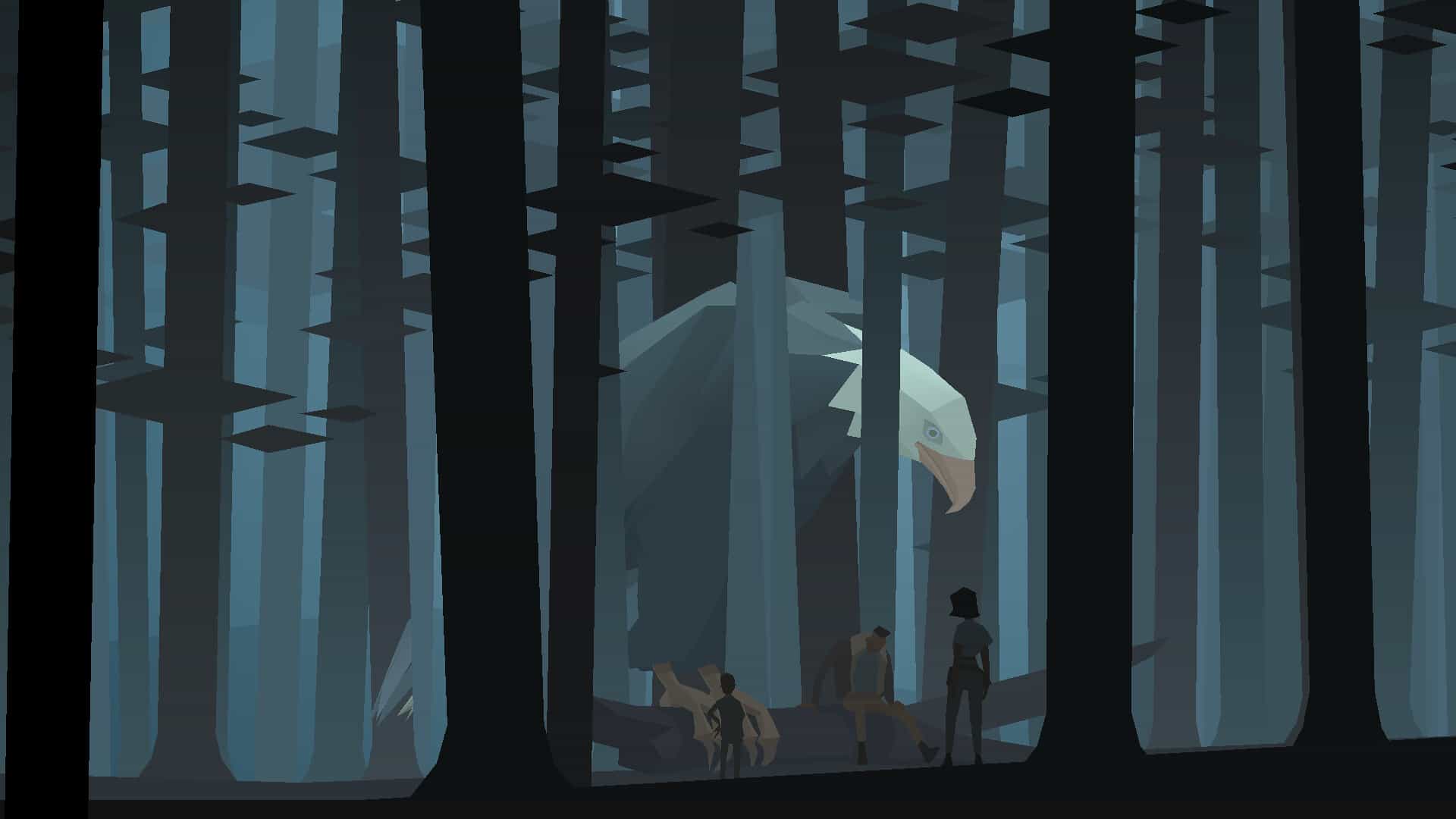
It’s taken me a couple of months of protracted slow progress to finally finish Kentucky Route Zero – I finally saw credits last week – and I’ve been ruminating on some thoughts about game dialogue systems. So since I’m now getting dragged into the high-adrenaline loop of Marathon, it seemed an appropriate time to sit down and try to structure some impressions on game narratives and more specifically – game dialogue.
So, before getting into Kentucky Route Zero, it’s important to outline an obvious, but less discussed-than-I’d-like point about the video game medium as an art form. The discourse often circles around the topic that games trigger certain emotions, without directly breaking down how that’s achieved. For example- Marathon, right now, is causing me short bursts of adrenaline-fueled anxiety. And, in comparison, KRZ floated on a continuous stream of calm melancholy.

Obviously, games are this unique experience, because they’re interactive. Interaction has the capacity to provide a significant emotional impact, when done right- it’s just somewhat rare to find games that use the medium’s strengths to do so. An easy example is the horror genre- horror films are a personal favourite, although they are much easier to endure, because of the understanding that they mostly wash over the viewer and they end. The movie itself is the driving force and we, the audience, are an outside observer. Games require you to participate. The recent Silent Hill 2 Remake is tremendous, and I couldn’t finish it. Specifically, because it, as well as the original, understands that it’s not enough to show you visuals to be able to feel authentic fear, the game also needs to make you feel vulnerable in other ways. And similarly, to loop back around, Marathon, right now, is making me just vulnerable enough to feel a constant low-level anxiety, while giving me enough breadcrumbs of power, to understand that I’m not completely helpless – leading to periodic adrenaline spikes. And also occasional fear, when I misperceive said breadcrumbs as more than breadcrumbs.
Now that that’s out of the way- let’s talk about how narrative-driven games evoke emotion- specifically, the aforementioned, Kentucky Route Zero and, another game I really liked from last year- Dispatch. Naturally, a big part is the narrative itself – but, as with horror, the games that make us connect emotionally are the ones that also care about how to involve the player further.
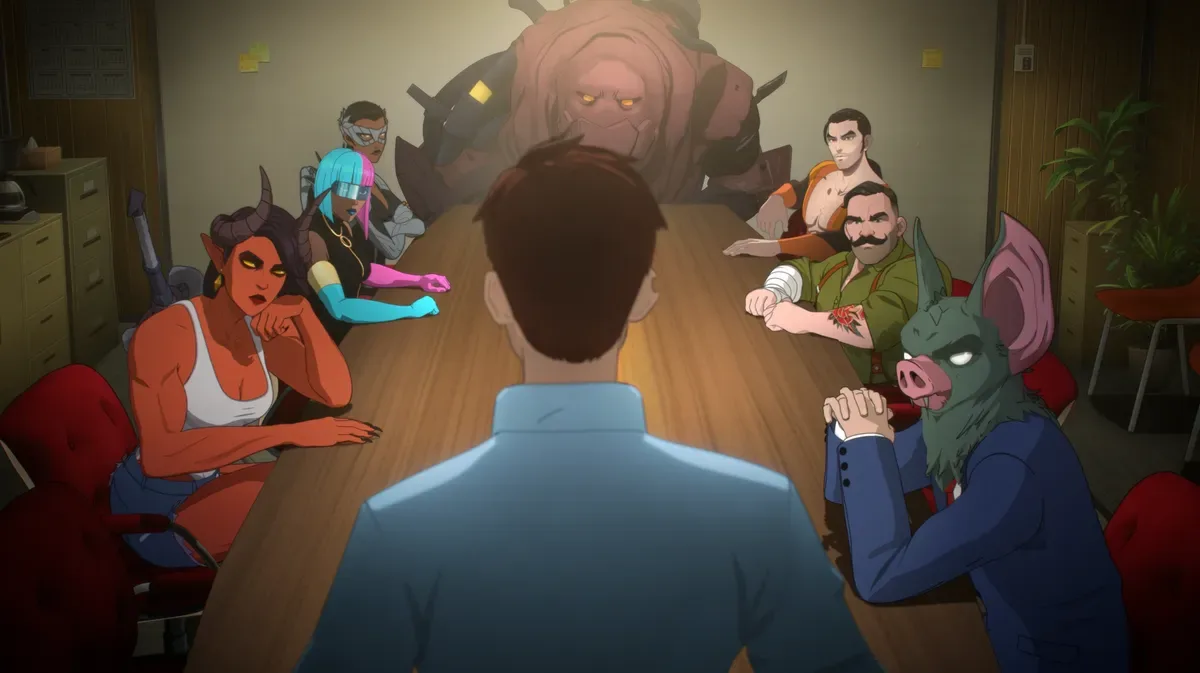
So it makes sense that Dispatch, created by a team with a legacy at Telltale, understands that player choice, presented in dialogue, is a key tool to give a player agency. The decision-making aspect gives a player responsibility and when the choices relate to characters we like and relate to – the emotional gut punch is harder.
Dispatch uses this tool really well. The main character is, both, a superhero, and a line manager, so the notion of having to make decisions, often under pressure, by talking to people, is in complete Thematic Unity with the narrative. I reject the notion that the timed element of the dialogue is a point of friction- to me it’s a vital gameplay element. All of the interactive elements don’t make a great narrative on their own, obviously, in this case they’re built around an expertly paced- and witty plot.
I do, however, want to point out that the responsibility element of the decision making, here, does a lot of the work. The Dispatch narrative is built around appealing to one of two parties, and a lot of the decisions work in relation to that dynamic. So a part of the emotional experience here comes from the fact that a certain dialogue choice would appeal- or disappoint a certain character. Maybe responsibility is the wrong word here, perhaps it is guilt?
Dispatch also seems to create emotion by framing the narrative around appealing to one of two attractive cartoon women, so I’d, actually, love to hear if it worked the same for female players.
This structure of decisions in a video game narrative is an old RPG narrative tool – usually its making world-defining decisions in favour of fantasy factions, or in relation to characters from conflicting tragic backgrounds- looking at you Wrex. So, besides the guilt/responsibility angle above, other decisions in Dispatch, and say, Mass Effect, are driven by rationality- why would I fire Coupe, when her and Punch Up have just started developing a synergetic relationship. The decision-making there doesn’t guarantee an emotional impact, unless a certain character is already relatable.
And, I guess, the above decision was the game engaging the managerial part of my brain – so another point for Thematic Unity.
(Psst- for more on Thematic Unity and the insightful teachings of one Ben Blaine – go subscribe to The Midpoint!)
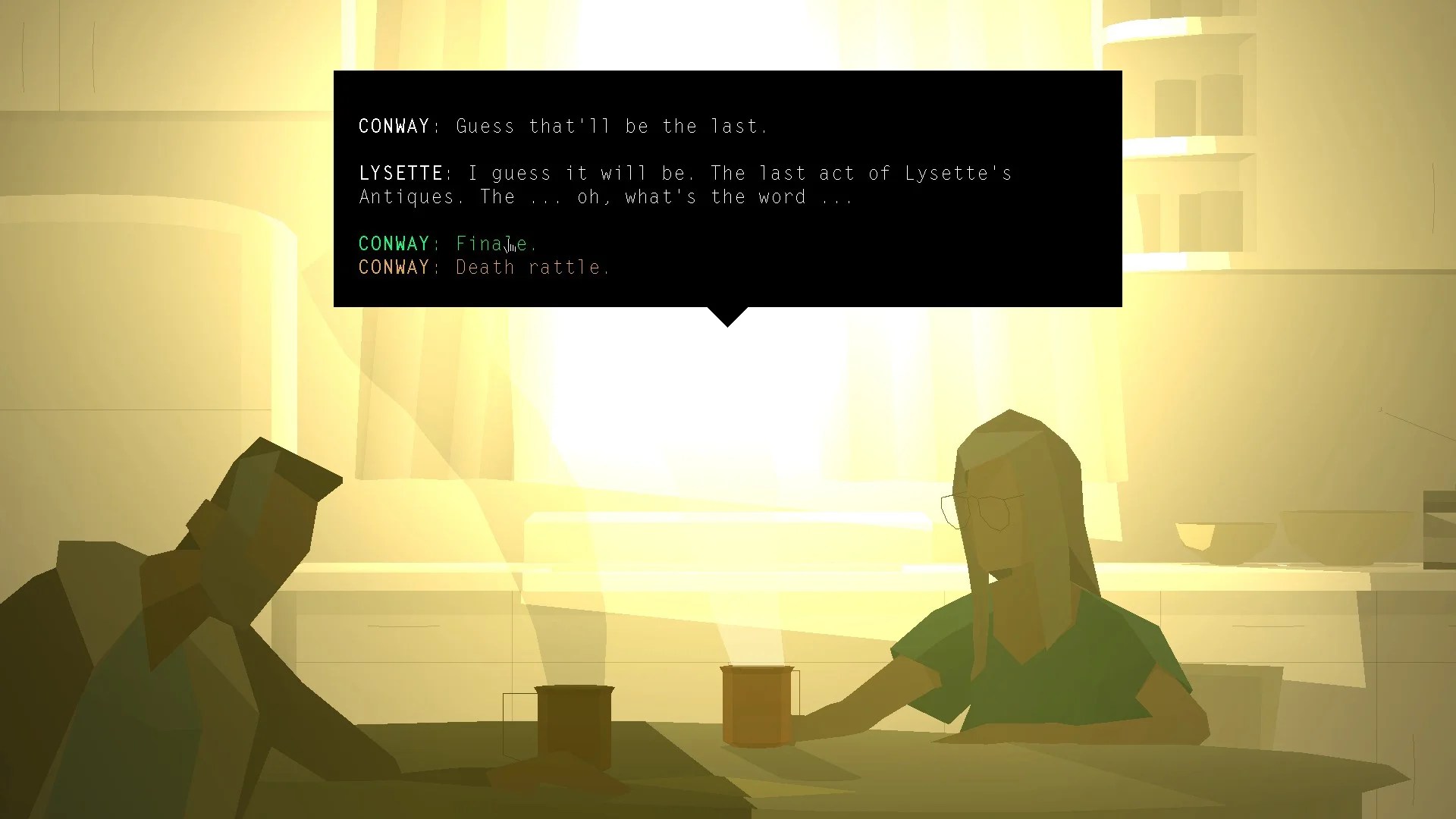
So – back to Kentucky Route Zero – a game that achieves emotional attachment purely via dialogue choice. KRZ is truly gorgeous and swept me up on these waves of melancholy like nothing else. The narrative, broadly, is about Conway, a delivery driver, needing to deliver some old furniture to 5 Dogwood Drive, just off the Zero. It’s a fantastical realism story that, to me, at least, was something of a metaphor for the journey of life.
Cardboard Computer (the cardboard computers?) also understand the concept of player agency by decision making and that for their story, grand decisions and rational character outcomes are not important. After all, a core theme of the story is that the point of life is different to different people and that, perhaps, sometimes, life is random/unfair and we have to move on.
So KRZ employs a dialogue choice system, but cleverly makes the outcomes not really matter to the overall narrative. There are certain branches, but all they impact is which different small narrative snippets the player sees.
The dialogue system, however, matters tremendously to how the player relates to the characters emotionally. The branching dialogue is curated to choices that, usually, relate to the characters themselves, or their background- e.g. a question the game poses early on is what Conway’s dog is called – Homer, Blue or “It’s just some dog”.
I argue this achieves a tremendous emotional effect by leaving the justification behind the name to the player’s own mental projection on the character. Nothing changes about Homer- my dog’s name in my playthrough- but, in my head, when the question appeared, the game started the roll of the emotional snowball. Not naming the dog seems cruel, as it’s mentioned he’s been alongside Conway for a while. And Blue seems a bit sad – after all, look at the cool hat he’s wearing on the game’s cover art. So- Homer it is! Oh hey, Homer!
It’s a very clever use of player agency and the game kept providing me with emotional gut punches the whole way just by employing the same tactic. Specifically there is a dialogue choice later on in the game, where a character leaves the group and you’re faced having to explain to Ezra, a young boy from the group, what’s happened to said character. The game presents you with the option to say that said character “Left” or “Was taken”. Neither of these impact Ezra in the game, but that choice felt very hard for me emotionally.
It’s worth pointing out that the above works, like in Dispatch, also for reasons of Thematic Unity.
The game’s theme that we might not always be able to influence the journey of life works hand in hand with making choices that don’t actually affect the journey. And, similarly, it doesn’t matter if the choices are made quickly here, unlike in Dispatch. The general pace is much more contemplative and is benefited by one taking their time. KRZ would suffer from a more active choice system, where one needs to constantly think about what conversations characters will remember and who not to alienate.
This approach of dialogue writing also feels very natural and human. Conversational authenticity is quite hard in games, as, unlike, say, film – games don’t often have a stable base for authentic dialogue outside of cutscenes. I.e. it’s hard to guarantee a player will experience something a certain way, unless their interaction is restricted.
Maybe that’s why I also really love both Oxenfree games – Night School Studio achieves this same authenticity through their exceptional conversation system, where cross-talk and interruptions are common. Something I can’t ever un-see now in other games. And they also use similar emotional tools, as KRZ, where the conversations between the teens are often personal and inconsequential, relying on the player’s introspection to build up the relationship.
And maybe maybe that’s why I’m struggling with the dialogue system in Baldur’s Gate 3 – an example of the aforementioned traditional RPG dialogue with impactful choices. But that’s one I haven’t thought about for very long and maybe one for a future blog.
As the increasing count of the word “maybe” suggests, I’m not sure if I have a grand point to end this on, just some musings about clever and purposeful game dialogue. But potentially a thought to leave you with- is Thematic Unity why I find myself shooting other players on sight in Marathon? And why isn’t that the default reaction of players in Arc Raiders?
 Lachezar Hubanov